Please Don't Stop Asking
Nov 01, 2026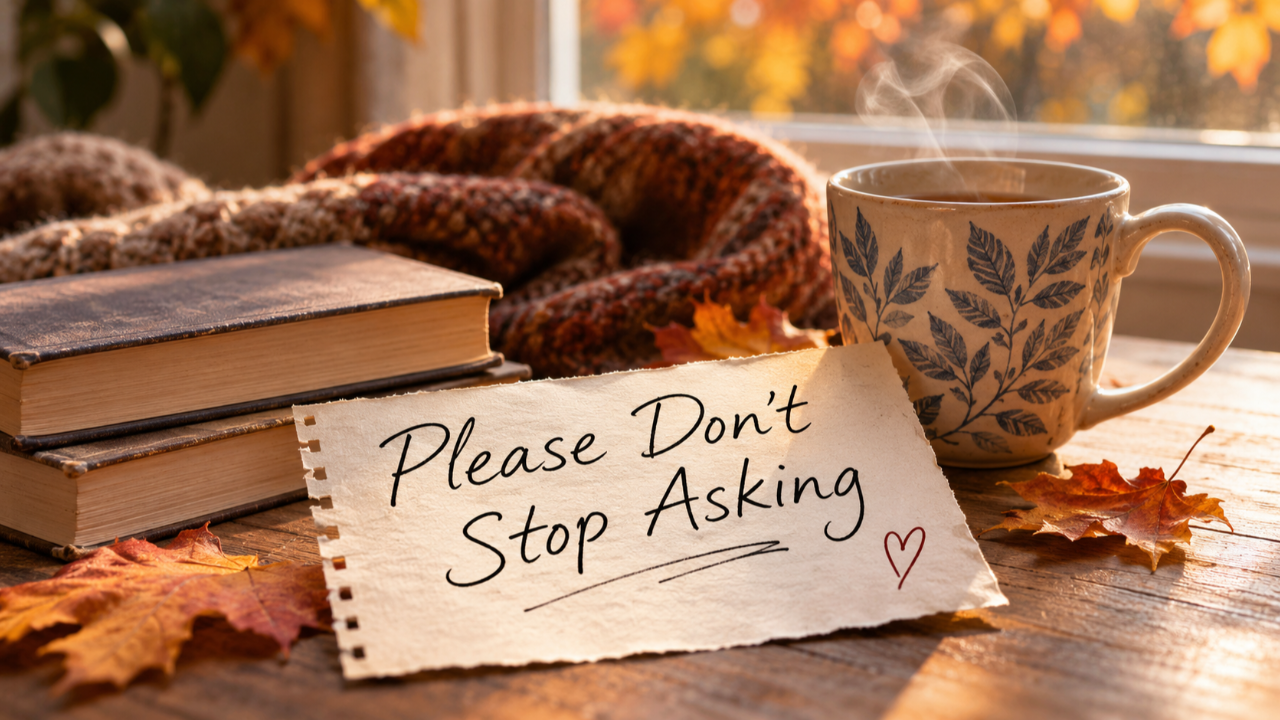
Happy Sunday and welcome to November,
It's been a little while since I last appeared in your Sunday inbox. Somehow September turned into October, October disappeared, and here we are in November. I'm beginning to suspect someone has been fiddling with the calendar.
I hope you're keeping well and have a cuppa to hand, perhaps with a biscuit or two. There's something rather comforting about a Sunday at this time of year, especially when you've got a good book waiting for you.
And speaking of books, I've been thinking a lot about stories recently. Not just the ones we read or write, but the ones we tell ourselves about what's happening in our lives and, perhaps more interestingly, the ones we invent about other people.
One conversation in particular has stayed with me for years.
A neighbour of mine was struggling after her husband died. Every week or so, I'd ask whether she'd like to come for a coffee or perhaps go for a drive. Nothing elaborate. Just a little company and a change of scenery.
Every time, she said no.
After about four weeks, she said something I've never forgotten.
“I'm not ready yet, but please don't stop asking.”
I still think about that sentence.
It would have been easy to decide that she wanted to be left alone. Four refusals seemed like fairly convincing evidence, and I certainly didn't want to become the neighbour who wouldn't take a hint.
But that wasn't what she was telling me.
She wasn't ready for company, yet she wanted to know the invitation was still there. She needed space, but she also needed connection. The two weren't mutually exclusive.
And it made me wonder how often we mistake someone's response for the whole story, when we're only seeing a small part of what they're experiencing.
That's what we're exploring today, so let's dive in.
The stories we create about other people
We're remarkably good at filling in the gaps.
Someone doesn't reply to a message, and we decide they're annoyed with us. Someone seems distant, and we assume they're unfriendly. Someone declines an invitation, and we conclude they'd rather not see us.
Sometimes we're right, of course. People can be unfriendly, and occasionally someone really is ignoring our messages. Not every misunderstanding is hiding a lovely surprise.
But sometimes we're spectacularly wrong.
What fascinates me is how quickly we move from this happened to I know what it means. And once we've decided what something means, we tend to behave as though our interpretation is an established fact.
We become cooler towards someone. We stop inviting them. We withdraw or become defensive. Before long, two people can be responding to assumptions neither has ever questioned.
If you've ever attended a family gathering, you'll know how easily that happens. One person remembers a perfectly pleasant Sunday lunch, while another is still recovering from a remark about the roast potatoes made in 1997.
Same lunch and two entirely different stories.
And what about the stories we tell ourselves?
There's another side to this, one I've spent many years exploring through NLP and the relationship between language, perception and experience.
Sometimes we don't just interpret other people's behaviour, we begin to see ourselves through their interpretations of us.
Perhaps we've been described as difficult, oversensitive, awkward or not quite good enough. Perhaps we've repeatedly been misunderstood, or discovered that expressing what we really think makes other people uncomfortable.
Over time, we may begin adapting ourselves to avoid those reactions. We agree when we'd rather say no. We hold back an opinion. We become so accustomed to accommodating other people's expectations that we barely notice we're doing it.
Of course, those responses may have developed for very good reasons. Our experiences are real, and sometimes adapting has been necessary.
But I wonder how often we continue living by an old interpretation long after the circumstances have changed.

What fiction can teach us about being human
I've been exploring these ideas from another angle recently as I prepare for Fall Fictionfest, my upcoming five-week creative writing experience.
Two novels in particular have caught my attention.
In Reminders of Him by Colleen Hoover, Kenna is a woman whose past has already shaped what other people believe about her. As readers, we're given access to thoughts, regrets and intentions that the other characters cannot see.
We understand things they don't, and that difference creates enormous emotional tension. We can recognise why some of the judgements exist while desperately wanting the characters to see beyond them.
Then there's Outlier by Susie Tate, which explores the distance between someone's internal experience and the way other people interpret their behaviour.
What struck me most was the inner dialogue, particularly in the portrayal of autistic experience and the painful consequences of trying to meet other people's expectations while losing sight of your own needs.
In both books, the reader is invited to understand something that the people within the story cannot yet see.
And that, to me, is one of fiction's extraordinary gifts.
We get to step inside another person's experience. We can discover the fears beneath their choices, the beliefs shaping their behaviour and the things they're struggling to say aloud.
We can also watch other characters get it completely wrong.
There are moments when I want to climb into a novel, grab two characters by the shoulders and say, “For goodness' sake, just TALK to each other!”
Although, admittedly, if fictional characters communicated perfectly, an awful lot of novels would be about twelve pages long.
And isn't that often the same in life?
The power of what isn't said
When I think back to my neighbour, what stays with me isn't simply that she wanted me to keep asking. It's how much she communicated in one short sentence.
“I'm not ready yet, but please don't stop asking.”
She didn't need to explain every feeling or describe the conflict she was experiencing. Her words revealed that she needed two things which might, at first glance, appear contradictory.
That's something we can learn from as writers and as humans.
We don't always need a character/person to explain what they're feeling. Sometimes the most powerful moments come from the gap between what they say, what they do and what we or the reader understands is happening beneath the surface.
A character might agree to something while their internal dialogue reveals the cost of that agreement. They might appear indifferent while desperately hoping someone will notice them. They might reject an invitation while wishing the other person would ask again.
And when we allow readers to recognise that difference for themselves, we create an emotional experience rather than simply describing one.
That's the kind of writing that stays with us.
And that's the kind of perspective that changes everything in everyday life.

A little something to ponder over your cuppa
Think about a recent interaction that didn't go quite as you'd hoped.
- What actually happened?
- What did the other person say or do?
- What meaning did you give it?
- And what else might have been happening that you couldn't see?
I'm not suggesting you should dismiss your interpretation as it might be entirely accurate. And perhaps there's room for another possibility.
Take it a step further. Imagine that same interaction from the other person's perspective. What might they have been thinking, feeling or trying to protect?
If you are a writer you might discover the beginning of a rather interesting scene.
An invitation to Fall Fictionfest
This exploration of perspective, inner dialogue, emotional conflict and character transformation is at the heart of Fall Fictionfest, starting Monday 9 November.
Over five weeks, we'll examine contemporary novels, including Reminders of Him and Outlier, to understand how writers create emotional connection and how we can bring those techniques into our own stories, whatever genre we write.
We'll be looking beyond what happens in a story to discover why it matters to the reader, and how we can create those moments in our own work.
If that sounds like something you'd enjoy, I'd love you to join us.
Find out more about Fall Fictionfest:
https://www.creativewritingtips.club/fall-fictionfest-1
In the meantime, enjoy your Sunday, and perhaps give someone the benefit of another possible interpretation this week.
You never know what story you might be missing.
Heather
Coach, writer, and strategist at the intersection of language, NLP and AI, helping humans reclaim identity, time, and impact.
Email: [email protected]
Website: heathervmasters.com
Choosing Happy: choosinghappy.space
Start With AI: startwithai.online
Creative Writing Tips: Creativewritingtips.club
P.S. The free coffee-and-chat is always open if this stirred something you'd rather talk through than type.
Stay connected with news and updates!
Join our mailing list to receive the latest news and updates from our team.
Don't worry, your information will not be shared.
We hate SPAM. We will never sell your information, for any reason.